Start with the Scottish rules
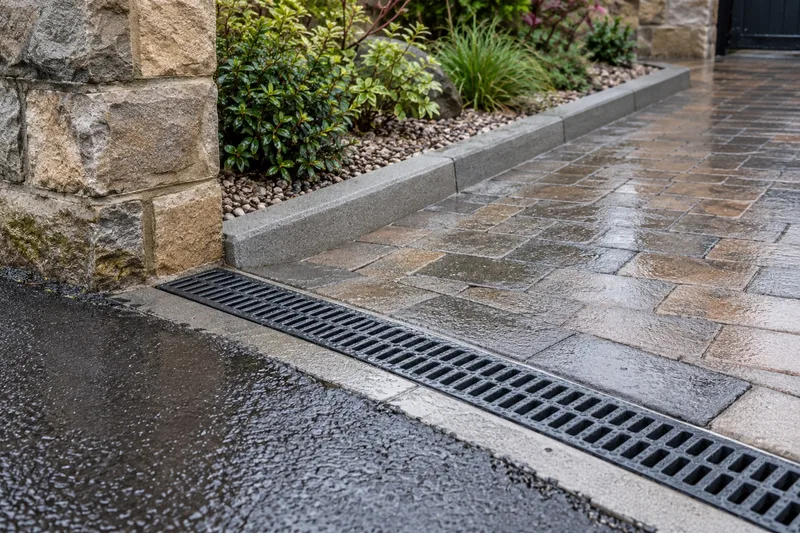
Scottish Government guidance describes householder rights for hard surfaces under Class 3C. Where a hard surface sits between a house and a road, the condition concerns porous materials or directing runoff to a porous area within the property.
These rights do not cover hard surfaces in conservation areas or within the curtilage of a listed building. Other restrictions may also apply. Ask the planning authority about the specific property; do not import England’s commonly quoted 5m² rule into a Scottish project.
Source reviewed 30 September 2026: Scottish Government: Circular 1/2024, hard surfaces (Class 3C).
A material name is not a drainage design
Ask how the complete driveway handles water, including its base and the ground below. A channel without a suitable destination simply moves the collection point.
Record where water already pools or runs in heavy rain. Share photographs with the person assessing the work, along with any known drains or underground services.
Check the public access separately
If the proposal creates or changes access over a public footway, speak to the relevant roads authority about its vehicle-crossing process. Approval for work within a private garden does not by itself establish permission to alter a public kerb.
Confirm who is responsible for each application or approval before ordering the work. If the property is outside Glasgow City, use the council responsible for that address.
Bring these details to the discussion
A simple sketch and a few photographs make a more useful starting point than a surface choice alone.
- The property address and any known conservation or listed status
- Existing and proposed driveway area
- Whether the vehicle access changes
- The intended surface and drainage approach
- Any neighbouring boundary or shared-access constraints